


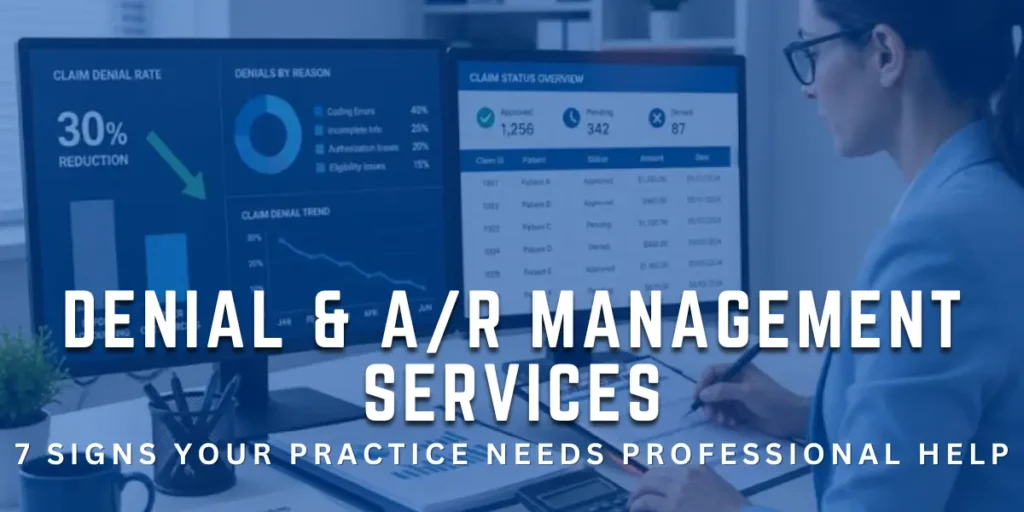
Medical practices work hard to deliver excellent patient care, but providing care is only one part of running a financially healthy organization. Behind every completed visit is a complicated revenue cycle involving claims, payer requirements, patient balances, reimbursements, follow-ups, and collections. When any part of that process begins to break down, revenue can quietly disappear.
This is where Denial & A/R Management Services can make a meaningful difference. Professional Denial & A/R Management Services help practices identify unpaid claims, understand why revenue is being delayed, and take action before aging accounts become increasingly difficult to recover. For organizations struggling with persistent denials or growing accounts receivable, Denial & A/R Management Services may be the missing piece in an otherwise capable revenue cycle operation.
But how do you know when professional support is actually necessary?
Some warning signs are obvious. Others develop gradually and may not receive attention until cash flow becomes a serious concern. A practice may have a busy schedule, a dedicated billing team, and strong patient demand while still losing substantial revenue through preventable billing problems.
The good news is that these issues can be identified and addressed. Understanding the seven signs below can help practice leaders determine whether their current approach is protecting revenue or allowing avoidable financial leakage.
1. Your Claim Denial Rate Keeps Increasing
Claim denials are an unavoidable part of healthcare billing, but consistently high or increasing denial rates should never be treated as business as usual.
A denial represents more than an unpaid claim. It can mean additional staff work, delayed reimbursement, increased administrative costs, and greater risk that the balance will eventually become difficult to collect. When denials accumulate faster than your team can resolve them, the problem becomes a revenue cycle bottleneck.
Professional Denial & A/R Management Services focus on identifying the underlying causes of denials rather than simply correcting individual claims. A strong denial management process examines patterns across payers, providers, procedures, documentation, eligibility, coding, authorization, and submission processes.
Why recurring denials deserve attention
A practice can spend considerable time resubmitting claims without addressing the reason those claims were rejected in the first place. That creates a cycle in which the same problem repeatedly consumes staff resources.
The goal should not simply be to work denials faster. It should be to prevent unnecessary denials from occurring.
A professional review can help determine whether your practice has systemic problems that require process improvements. When recurring denial patterns are identified early, corrective action can protect both current and future revenue.
2. Your Accounts Receivable Is Aging Too Quickly
Accounts receivable, commonly referred to as A/R, represents money owed to your practice. Healthy A/R management requires consistent monitoring because the likelihood of successful collection generally becomes more challenging as balances age.
If your practice has a growing volume of accounts sitting in older aging categories, that deserves immediate attention.
Denial & A/R Management Services can provide structured oversight of outstanding balances and help prioritize accounts according to age, payer, balance, status, and collection opportunity. Instead of allowing unpaid claims to remain in a queue indefinitely, professional A/R management creates a systematic approach to follow-up and resolution.
Aging A/R can hide a larger problem
A large A/R balance may initially appear positive because it represents money that has not yet been collected. In reality, aging receivables can place significant pressure on cash flow.
The important question is not simply, “How much money is outstanding?”
A better question is, “How much of that money is realistically collectible, and how quickly can it be recovered?”
That distinction matters. Effective A/R management turns raw outstanding balances into actionable information. It helps leadership understand where revenue is delayed, why it is delayed, and what should happen next.
3. Your Billing Team Is Overwhelmed by Follow-Up
Revenue cycle work can become remarkably labor-intensive. Staff members may spend their days checking claim statuses, contacting payers, correcting billing issues, reviewing correspondence, submitting appeals, and following up on outstanding balances.
When the workload becomes too large, even experienced employees can struggle to keep up.
This is one of the clearest indicators that your practice may benefit from Denial & A/R Management Services.
Outsourcing specialized revenue cycle functions does not necessarily mean replacing your internal team. In many situations, it can allow existing employees to focus on the responsibilities they handle best while experienced professionals manage complex follow-up and A/R activity.
Staff capacity affects revenue performance
When employees are constantly reacting to urgent billing issues, there is little time available for analysis and prevention.
That creates a reactive revenue cycle.
Professional support can introduce dedicated processes for tracking outstanding claims, identifying priority accounts, documenting payer responses, and escalating unresolved issues. The result is a more organized workflow that is less dependent on individual employees remembering what needs attention.
Your billing team should have the time and tools necessary to do its work properly. If they are perpetually buried under an expanding A/R workload, it may be time to reconsider how those responsibilities are managed.
4. You Do Not Have Clear Visibility Into Your A/R
Good financial management depends on reliable information.
If practice leaders cannot easily determine how much is outstanding, where the balances are concentrated, which claims are delayed, or what is happening with aging A/R, decision-making becomes much harder.
Denial & A/R Management Services can bring greater structure and visibility to the revenue cycle by organizing outstanding accounts and monitoring key performance indicators.
A practice should be able to assess its revenue cycle using meaningful measurements rather than assumptions.
Metrics that deserve regular attention
Important A/R and denial indicators can include:
- Overall A/R aging
- Days in accounts receivable
- Denial rates
- Claim resolution rates
- A/R by payer
- A/R by aging category
- Outstanding claim volume
- Appeal activity
- Collection performance
The value of these metrics comes from understanding what they reveal.
For instance, an increasing A/R balance may require a completely different response depending on whether the increase is related to payer delays, unresolved denials, patient balances, authorization issues, or internal billing processes.
Data gives leadership a clearer view of where attention is needed.
5. Your Practice Is Losing Revenue to Preventable Denials
Not every denial is avoidable. Payers have complex rules, policies change, and certain claims require additional review. However, preventable denials should be treated as opportunities for improvement.
When your practice repeatedly encounters problems caused by eligibility issues, authorization requirements, incomplete information, coding inconsistencies, timely filing concerns, or documentation gaps, those patterns should be investigated.
Professional Denial & A/R Management Services can help uncover recurring sources of preventable revenue loss and establish processes designed to reduce them.
Prevention is more valuable than repeated correction
Correcting a denied claim after it has already consumed time and entered the A/R system is important. Preventing that denial from happening in the first place is even better.
That requires collaboration across the revenue cycle.
Front-office registration, eligibility verification, authorization, clinical documentation, coding, billing, and follow-up can all influence whether a claim is paid correctly.
A denial management strategy should therefore look beyond the billing department. The strongest approach considers the entire path from patient scheduling through reimbursement.
6. Your Cash Flow Is Becoming Unpredictable
Cash flow matters enormously to every medical practice.
Payroll, technology, supplies, facility expenses, professional services, and other operational costs continue regardless of whether insurance payments arrive on time. When reimbursement becomes unpredictable, leadership may find itself making difficult decisions based on incomplete financial visibility.
Persistent payment delays and unresolved A/R can contribute to this instability.
With Denial & A/R Management Services, practices can establish a more disciplined approach to unpaid claims and outstanding balances. Systematic follow-up helps reduce the likelihood that collectible revenue will simply remain dormant.
Revenue delays can affect more than accounting
When cash flow is inconsistent, the impact can extend throughout the organization.
Leadership may postpone investments, limit operational improvements, or spend excessive time dealing with financial uncertainty. Administrative teams may become frustrated by constantly changing priorities. Providers may also become concerned when revenue performance does not reflect the volume of services being delivered.
A well-managed revenue cycle supports stability.
It does not guarantee that every claim will be paid quickly, but it can create stronger processes for identifying delays, addressing problems, and recovering legitimate reimbursement.
7. Your Team Is Spending More Time Managing A/R Than Growing the Practice
There comes a point when administrative work begins taking attention away from strategic priorities.
Practice leaders should be thinking about patient experience, provider productivity, service development, staffing, operational efficiency, and long-term growth. If they are instead spending significant time investigating unpaid claims and aging balances, something may need to change.
Denial & A/R Management Services can help shift the burden of specialized revenue recovery away from practice leadership and toward professionals whose processes are built around this work.
That can give internal teams more room to concentrate on patient care and practice operations.
Specialized support can improve operational focus
Revenue cycle management requires attention to detail, persistence, payer knowledge, documentation, reporting, and continuous follow-up.
It is not always practical for a busy practice to maintain the necessary level of specialization internally.
Professional support can provide additional expertise while establishing accountability around outstanding claims and receivables. The objective is not merely to collect money. It is to create a revenue cycle that operates with greater consistency and transparency.
Why Professional Denial and A/R Management Matters
When a practice experiences one or two of these warning signs, the problem may still be manageable internally. When several appear at the same time, however, the financial consequences can become much more significant.
Denial & A/R Management Services provide a structured approach to one of the most important areas of practice financial performance.
Effective management typically involves reviewing outstanding claims, prioritizing aging accounts, monitoring payer activity, identifying denial trends, supporting appeals, and improving processes that contribute to preventable revenue loss.
The real value lies in connecting these activities rather than treating each unpaid claim as an isolated problem.
A practice should know not only what it has failed to collect, but also why collection has not occurred and what can be done about it.
How the Right A/R Strategy Strengthens Your Revenue Cycle
A successful revenue cycle is not built around chasing payments after problems occur. It is built around prevention, visibility, accountability, and consistent follow-up.
Denial & A/R Management Services can support that strategy by creating a repeatable process for managing unresolved balances and identifying opportunities for improvement.
The right approach should align with the practice’s specialty, payer mix, workflow, staffing model, and financial objectives. A generic process may not address the specific challenges affecting your organization.
That is why evaluation matters.
Before choosing a revenue cycle partner, practices should consider experience, reporting capabilities, communication processes, technology, payer knowledge, compliance practices, and the organization’s ability to measure results.
Choosing the Right Revenue Cycle Partner
Not every billing company approaches denial and A/R management in the same way.
A reliable partner should be willing to look beyond surface-level numbers and understand the operational factors influencing those numbers.
Ask whether the organization provides meaningful reporting. Determine how unresolved accounts are prioritized. Understand how denial trends are analyzed and how information is communicated back to your practice.
Transparency should be central to the relationship.
You should be able to understand what is being worked, what has been recovered, what remains outstanding, and where recurring problems are originating.
A strong partnership also requires communication. Revenue cycle management should not feel like a black box that disappears somewhere outside the practice. Your team should have appropriate visibility into performance and outstanding issues.
Protect Your Practice From Revenue Leakage
Revenue leakage can happen quietly.
A claim may remain unresolved. A denial may not receive timely attention. An aging account may move from one work queue to another without meaningful progress. Individually, these situations may appear minor. Collectively, they can create a substantial financial burden.
Denial & A/R Management Services help practices take a more deliberate approach to protecting revenue that has already been earned.
That distinction is important. Revenue cycle improvement is not simply about increasing collections. It is about making sure the organization has processes capable of capturing and recovering appropriate reimbursement efficiently.
When those processes are strong, financial performance becomes easier to monitor and operational decisions become more informed.
Is Your Practice Ready for Better A/R Management?
The seven warning signs discussed above all point toward the same underlying issue: your practice may be working harder than it should to collect revenue it has already earned.
Increasing denials, aging receivables, overwhelmed staff, limited reporting visibility, preventable billing problems, unpredictable cash flow, and excessive administrative workload should not be ignored.
Denial & A/R Management Services can help bring structure to these challenges by combining denial resolution, A/R follow-up, reporting, analysis, and process improvement into a coordinated strategy.
For practice leaders, the goal should be straightforward: reduce avoidable revenue delays, improve financial visibility, and create a revenue cycle that supports long-term stability.
At May Medical Solutions, professional revenue cycle support can help practices take a more organized approach to denial and A/R management. Instead of allowing unresolved balances to become tomorrow’s financial problem, practices can establish processes designed to address them today.
The question is not whether your practice has A/R. Every practice does.
The more important question is whether your current process is managing that A/R effectively.
If the answer is uncertain, it may be time to take a closer look.