


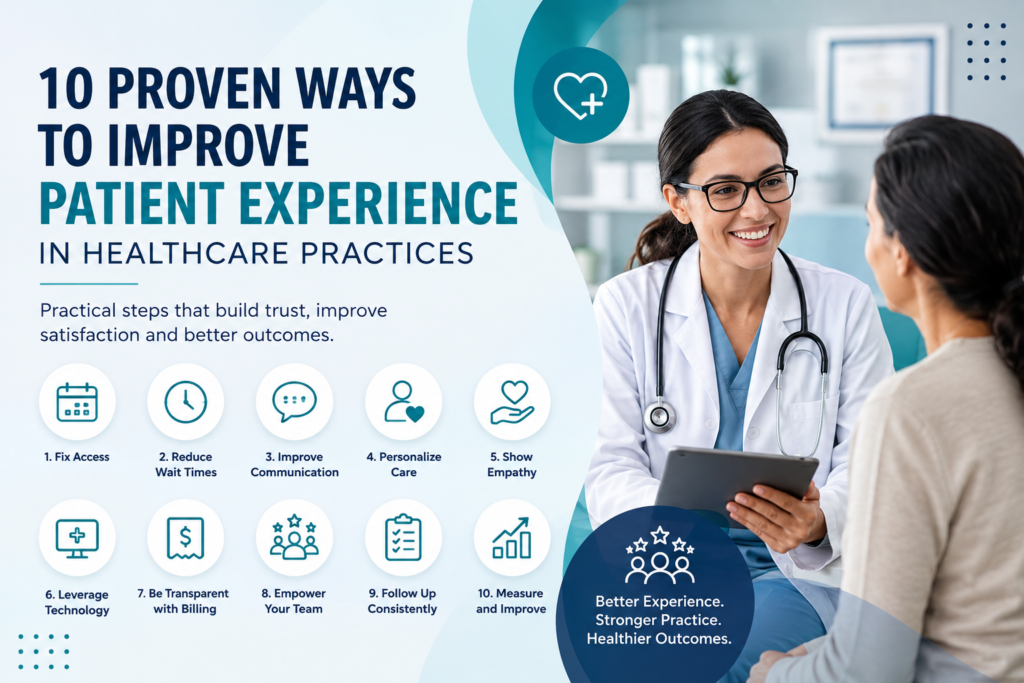
Patient experience has quietly become the metric that decides whether a healthcare practice thrives or struggles to keep its doors full. Clinical skill still matters, of course, but patients rarely evaluate a practice the way a medical board would. They judge it by how long they waited on hold, whether the front desk smiled, how clearly the nurse explained a prescription, and whether the final bill matched what they were told it would cost.
That gap between “we deliver good medicine” and “patients feel good about us” is where most practices lose ground. Nearly three in four adults say the healthcare system fails to meet their needs in some way, and trust in the industry has fallen sharply over the past several years. The good news is that patient experience is not a mystery. It is a set of specific, fixable touchpoints, and practices that invest in them see the payoff in loyalty, referrals, and better clinical outcomes.
This guide walks through fifteen practical, research-backed ways to improve patient experience in healthcare practices, from the first phone call to the final follow-up.
Why Patient Experience Deserves Its Own Strategy
Patient experience is not the same thing as patient satisfaction, and it is not the same thing as clinical quality. It refers to the sum of every interaction a patient has with a practice: scheduling, parking, the waiting room, the exam itself, billing, and any communication that happens after the visit ends.
Healthcare organizations that treat this as a strategic priority, rather than a byproduct of good clinical care, tend to see measurable returns. Patients who trust their provider are far more likely to recommend that practice to others, and word-of-mouth referrals remain one of the most cost-effective ways to grow a patient base. Just as important, patients who feel heard and respected are more likely to follow treatment plans, show up for follow-up appointments, and disclose the full picture of their symptoms, which directly improves clinical outcomes.
With that foundation in place, here is where to focus.
1. Fix Access Before You Fix Anything Else
Access is usually the first place patient experience breaks down. If people cannot get an appointment within a reasonable window, or if the phone rings endlessly before anyone picks up, nothing that happens inside the exam room can fully repair that first impression.
Start by tracking two numbers: average hold time on the main phone line and average number of days to the next available appointment. Most practices are surprised by how bad these look once measured. Online self-scheduling, same-day slots reserved for urgent needs, and a callback option instead of hold music are all low-cost fixes that address the most common source of frustration before a patient ever reaches the front desk.
2. Reduce Wait Times, or at Least Manage Them Honestly
Long waits remain one of the most consistently cited complaints in patient surveys. The fix is not always “see patients faster.” Sometimes it is simply communicating clearly. A patient who is told “the doctor is running twenty minutes behind” tolerates the wait far better than one who is left wondering if they were forgotten.
Practices that get this right typically do three things: they build realistic buffer time into the schedule instead of overbooking every slot, they use digital check-in and status boards so patients can see where they stand, and they train staff to proactively update anyone waiting more than ten minutes past their appointment time.
3. Train Staff on Communication, Not Just Clinical Skill
Communication about medicines and diagnoses is consistently one of the lowest-scoring areas on national patient experience surveys. This is not a knowledge problem. Most clinicians know the medical facts. It is a communication problem, and it is trainable.
Practices that invest in communication and empathy training for both clinical and front-desk staff see measurable improvements in how patients rate their visits. This includes basic techniques like teach-back (asking patients to repeat instructions in their own words to confirm understanding), sitting rather than standing during conversations, and using plain language instead of clinical jargon. These are small behavioral shifts, but they compound across every single patient interaction.
4. Personalize Care Using the Data You Already Have
For practices looking to improve scheduling, workflow efficiency, and day-to-day operations, medical practice management services can provide structured support across the patient journey. Personalization does not require a massive technology overhaul. It can be as simple as a nurse referencing a patient’s last visit before asking the same questions again, or a system that flags patients with chronic conditions for more frequent, tailored check-ins.
Patients notice when a provider remembers their history. It signals that they are a person being cared for, not a chart number being processed. Segmenting patients by behavior, preference, and health history also allows a practice to anticipate needs, such as sending a diabetic patient reminders timed around their specific care plan rather than a generic newsletter.
5. Close the Communication Loop Between Visits
Patient experience does not end when the appointment does. One of the most common breakdowns happens in the gap between visits, when patients are left to interpret lab results, medication instructions, or referral steps on their own.
Simple systems fix this: automated but personalized follow-up messages after procedures, a clear way to ask a question without booking a new appointment, and timely notification of test results with context rather than a raw number on a portal. Patients who feel supported after they leave the building are far more likely to stick with their treatment plan.
6. Make Billing Transparent and Predictable
Billing surprises damage trust faster than almost anything else in the patient journey. A patient can have an excellent clinical experience and still leave a scathing review because the bill was confusing, arrived late, or included charges nobody explained in advance.
Upfront cost estimates, plain-language billing statements, and staff who are trained to walk patients through insurance and payment options before treatment all reduce this friction. Clear billing processes are easier to maintain when practices have reliable medical billing and coding services supporting accurate claims, patient accounts, and revenue cycle workflows..
7. Invest in the Physical Environment
The waiting room and exam space send a message before a single word is spoken. Cluttered, noisy, or outdated spaces subtly tell patients that the practice does not prioritize their comfort. Quietness is, in fact, one of the lowest-scoring categories on standardized hospital experience surveys, which shows how much environment affects perception of care.
Comfortable seating, clean and well-lit spaces, reduced noise, and clear signage all matter more than practices tend to assume. This does not require a full renovation. Even modest changes, like better acoustic panels or a redesigned check-in counter that reduces overheard conversations, can noticeably shift how a visit feels.
8. Use Technology to Remove Friction, Not Add It
Digital tools can meaningfully improve patient experience, but only when they are used to simplify the journey rather than complicate it. Online scheduling, digital intake forms completed before arrival, secure messaging with the care team, and mobile check-in all reduce the friction patients feel at each step.
The key distinction is that technology should feel invisible when it works well. Patients should not need to download three different apps to manage one relationship with a single practice. Consolidating tools into a single patient portal, and making sure that portal is genuinely easy to use on a phone, matters more than adding new features for their own sake. Practices can strengthen their online presence and patient-facing digital journey through professional healthcare digital solutions designed around accessibility and patient engagement.
9. Build a Real, Continuous Feedback Loop
Practices that only ask for feedback once, at the very end of a long survey nobody wants to fill out, miss the moments that actually matter. Short, targeted feedback requests immediately after a specific touchpoint, such as a quick tap on “Was your wait reasonable?” right after checkout, generate far more useful and honest data than a lengthy annual survey.
The goal is not just to collect scores. It is to build a loop where feedback visibly changes something. When patients see that a complaint about noise led to a quieter waiting room, they trust that their input matters, and they are more likely to keep giving it.
10. Respect Patients’ Time as a Finite Resource
Adults spend a significant amount of time each year navigating the healthcare system: booking, waiting, traveling, and following up. Every minute a practice saves a patient is a form of respect that gets remembered. This means minimizing redundant paperwork, avoiding repeat questions across different staff members, and syncing systems so a patient does not have to explain the same medical history three times in one visit.
Bringing It All Together
Improving patient experience in a healthcare practice is not a single initiative with a start and end date. It is an ongoing discipline built from a series of smaller commitments: answering the phone faster, explaining a bill clearly, remembering a patient’s history, and following up after a difficult diagnosis.
None of these fifteen strategies require a massive budget to begin. Most start with better training, clearer communication, and a genuine willingness to look honestly at where patients are currently struggling. Practices that commit to this work consistently see the results they are looking for: higher patient loyalty, stronger word-of-mouth growth, and better clinical outcomes, because patients who trust their provider are patients who actually follow through on their care.
The practices that will stand out in the years ahead will not necessarily be the ones with the most advanced technology or the largest facilities. They will be the ones that never lose sight of the fact that behind every chart, appointment, and billing statement is a person who simply wants to feel heard, respected, and cared for.
About May Medical Solutions
May Medical Solutions helps healthcare practices turn strategies like these into reality, through professional websites, targeted SEO, EMR/EHR integration, and billing and revenue cycle support built specifically for medical providers. If your practice is ready to improve patient experience and grow its online presence, visit maymedicalsolutions.com to learn more.
Frequently Asked Questions
What is patient experience in healthcare?
Patient experience refers to the sum of every interaction a patient has with a healthcare practice, including scheduling, wait times, communication with staff and clinicians, the physical environment, billing, and follow-up care. It is distinct from patient satisfaction, which measures whether expectations were met, and from clinical quality, which measures medical outcomes.
What is the fastest way to improve patient experience?
Access and communication typically offer the fastest wins. Reducing phone hold times, offering online scheduling, and training staff to explain wait times or medication instructions clearly can produce noticeable improvements within a few months, often without major budget or technology investment.
Why is patient experience important for a healthcare practice?
Patient experience directly affects trust, loyalty, and referrals. Patients who trust their provider are far more likely to recommend the practice, follow treatment plans, attend follow-up appointments, and disclose complete information about their symptoms. Poor experience, even alongside strong clinical care, tends to drive patients toward competitors and results in negative reviews.
How do you measure patient experience?
Common measurement tools include standardized surveys such as HCAHPS and CAHPS, post-visit feedback requests, likelihood-to-recommend scores, and targeted micro-surveys tied to a specific touchpoint, such as checkout or billing. The most effective practices track these metrics consistently and review them on a regular schedule rather than only during annual audits.
What role does technology play in improving patient experience?
Technology helps when it removes friction, such as through online scheduling, digital intake forms, secure messaging, and consolidated patient portals. It becomes a liability when it replaces meaningful human interaction or requires patients to juggle multiple disconnected apps. The most effective practices use automation to support staff, not replace the moments where patients need a human response.
Can small or independent practices improve patient experience without a big budget?
Yes. Many of the highest-impact changes, such as clearer communication, honest updates about wait times, transparent billing conversations, and empowering front-desk staff to resolve issues on the spot, cost little to nothing to implement. They depend more on training and consistency than on large capital investment.
About May Medical Solutions
May Medical Solutions helps healthcare practices turn strategies like these into reality, through professional websites, targeted SEO, EMR/EHR integration, and billing and revenue cycle support built specifically for medical providers. If your practice is ready to improve patient experience and grow its online presence, visit maymedicalsolutions.com to learn more.