


Medical Billing vs Medical Coding: What’s the Difference?
If you’ve ever scrolled through job listings for “medical billing and coding” and wondered whether that’s one job or two, you’re not alone. It’s one of the most common points of confusion for anyone exploring a career in healthcare administration and honestly, the industry doesn’t always do a great job of explaining itself.
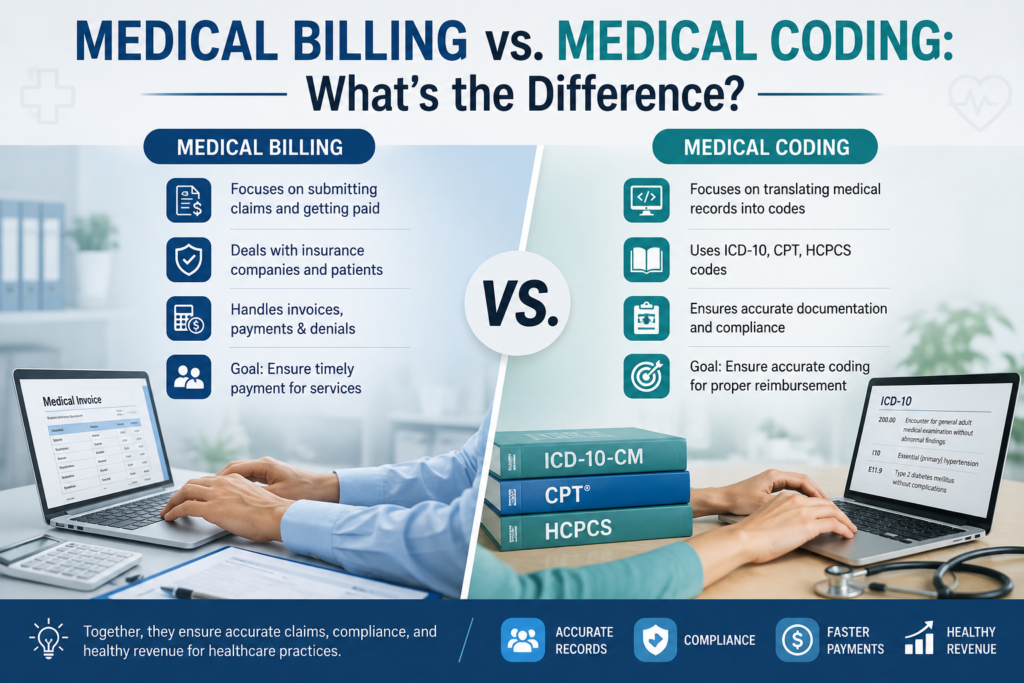
Here’s the short version: medical coders translate what happened during a patient’s visit the diagnosis, the procedure, the treatment into standardized alphanumeric codes. Medical billers take those codes and use them to build and submit insurance claims, then chase down payment. One role speaks the language of clinical documentation. The other speaks the language of money.
They’re often bundled together in job postings and training programs, and in smaller clinics, one person might genuinely do both. But at their core, they’re distinct disciplines with different skill sets, different daily tasks, and in many cases, different certifications.
Why does this distinction matter? For one, it affects your career decision if you’re weighing which path to pursue. It also matters for healthcare operations a breakdown between coding and billing is one of the biggest reasons claims get denied, payments get delayed, and patients end up with confusing bills. Understanding how these two roles fit together (and where they diverge) gives you a much clearer picture of how the healthcare revenue cycle actually works, whether you’re considering a job in the field or just trying to make sense of your own medical bill.
Let’s break down each role, then put them side by side.
What Does a Medical Coder Actually Do?
Think of a medical coder as a translator. A doctor writes notes like “patient presented with acute bronchitis, prescribed antibiotics, follow-up in two weeks.” A coder’s job is to convert that narrative into precise, standardized codes that insurance companies, government payers, and health systems can universally understand and process.
This isn’t just clerical busywork. Coding requires a solid understanding of anatomy, medical terminology, and payer-specific rules, because a single wrong digit in a code can change how a claim is processed or get it rejected outright.
The Major Coding Systems
Medical coders primarily work with three coding systems:
- ICD-10 codes (International Classification of Diseases, 10th Revision): These codes represent diagnoses and conditions. If a patient is diagnosed with type 2 diabetes, there’s a specific ICD-10 code for that and depending on complications or specifics, the code can get quite granular.
- CPT codes (Current Procedural Terminology): These describe the actual procedures and services performed an office visit, a lab test, a surgery. CPT codes tell the payer what was done, while ICD-10 codes explain why it was done.
- HCPCS codes (Healthcare Common Procedure Coding System): This system covers things CPT doesn’t fully address, like durable medical equipment (wheelchairs, walkers), ambulance services, and certain drugs administered outside a typical office visit.
A coder reviews the physician’s documentation notes, lab results, discharge summaries and assigns the appropriate combination of these codes. It sounds mechanical, but there’s real judgment involved. Documentation is often incomplete or ambiguous, and coders sometimes need to query physicians for clarification before finalizing a code set.
Where Coders Work
Medical coders work in hospitals, physician offices, outpatient clinics, insurance companies, and increasingly, from home as remote employees or contractors. Coding is one of the more remote-friendly roles in healthcare administration, since it’s largely computer-based and doesn’t require direct patient contact.
Skills and Certifications
To become a medical coder, you’ll typically need:
- A strong grasp of anatomy, physiology, and medical terminology
- Attention to detail (seriously this cannot be overstated)
- Familiarity with electronic health record (EHR) systems
- A recognized medical coding certification
The two most respected credentials are the CPC (Certified Professional Coder), offered by the AAPC, and the CCS (Certified Coding Specialist), offered by AHIMA. Employers often list one of these as a minimum requirement, and honestly, without a certification, breaking into coding can be an uphill climb. Most people complete a certificate program or associate degree before sitting for the exam.
What Does a Medical Biller Actually Do?
If coding is about translation, billing is about follow-through. Medical billers take the codes a coder has assigned and use them to build a claim essentially an invoice sent to an insurance company (or the patient directly) requesting payment for services rendered.
But billing is rarely a “submit and done” process. It’s more like project management for money.
The Claims Process, Step by Step
Here’s roughly how it plays out in a typical practice:
- The biller receives the coded information from the coding team (or, in smaller offices, does the coding themselves).
- They compile a claim, cross-checking that the codes align with the patient’s insurance plan and coverage rules.
- The claim gets submitted electronically to the payer usually through a clearinghouse that checks for basic errors before it even reaches the insurer.
- The insurance company reviews the claim and either pays it, partially pays it, or denies it.
- If a claim is denied or underpaid, the biller investigates why, corrects the issue, and resubmits this is often called an appeal.
- Once the insurer’s portion is settled, the biller generates a bill for whatever the patient owes out of pocket, and follows up on collections if needed.
That last part is worth sitting with for a second. A biller isn’t just pushing paperwork they’re often the person calling insurance companies to ask, “Why was this denied?” and calling patients to say, “Here’s what you owe and why.” It requires a mix of persistence, diplomacy, and a thick skin, since payment conversations aren’t always pleasant.
Where Billers Work
Like coders, billers work across hospitals, private practices, billing companies, and insurance firms. Many billing roles are also remote or hybrid, especially at larger billing service companies that handle claims for multiple clients.
Skills and Certifications
Successful billers tend to have:
- Comfort with numbers and financial processes
- Strong communication skills (you’re dealing with insurers and patients constantly)
- Familiarity with billing software and clearinghouse systems
- Patience appeals and follow-ups can take weeks
Relevant credentials include the CPB (Certified Professional Biller) from the AAPC and the CMRS (Certified Medical Reimbursement Specialist). A medical billing certification isn’t always mandatory to land an entry-level job, but it significantly improves your competitiveness and earning potential.
Medical Billing vs Medical Coding: A Side-by-Side Comparison
So is medical billing the same as coding? No but they’re two halves of the same financial engine that keeps healthcare practices running. Here’s how they stack up directly.
| Dimension | Medical Coding | Medical Billing |
|---|---|---|
| Primary responsibility | Translating clinical documentation into ICD-10, CPT, and HCPCS codes | Using those codes to create, submit, and follow up on insurance claims |
| Stage in revenue cycle | Happens right after patient care, before a claim exists | Happens after coding, through to final payment collection |
| Type of data | Clinical diagnoses, procedures, medical records | Financial claims, reimbursement, patient balances |
| Key knowledge base | Anatomy, medical terminology, coding guidelines | Insurance policies, payer rules, collections processes |
| Typical work setting | Hospitals, clinics, remote coding firms | Physician offices, billing companies, insurance-facing roles |
| Common certifications | CPC, CCS | CPB, CMRS |
| Public-facing interaction | Minimal to none | Frequent communicating with patients and payers |
Which Pays More, Medical Billing or Coding?
This comes up constantly, and the honest answer is: it depends on experience, certification, specialty, and location, but coding tends to edge out billing slightly on average, particularly for coders with specialty certifications (like coding for cardiology or oncology, which pay a premium due to their complexity). That said, experienced billing managers or those who move into revenue cycle management roles can out-earn many coders. Neither path is a guaranteed ceiling both offer room to grow into supervisory or specialized positions that pay considerably more than entry-level rates.
How Billing and Coding Work Together
In practice, these two roles are deeply interdependent, and when the handoff between them breaks down, the consequences ripple through the entire revenue cycle.
Imagine a coder assigns a code that doesn’t quite match the documentation maybe it’s too vague, or it doesn’t support the level of service billed. The biller submits the claim anyway, unaware of the mismatch. The insurance company flags it, denies the claim, and now the practice has to spend time (and money) figuring out what went wrong, correcting it, and resubmitting. Multiply that by dozens of claims a week, and you can see how coding errors directly translate into delayed cash flow.
There’s a patient impact too. When claims get denied or delayed, patients are often left in limbo, receiving confusing statements or getting billed incorrectly for services their insurance should have covered. This is one of the fastest ways to erode patient trust in a practice nobody enjoys getting a surprise bill because of an internal paperwork issue.
That’s why many practices encourage tight communication between coders and billers, and why some professionals choose to become dual-certified in both. Understanding both sides of the process the clinical documentation side and the financial claims side makes you a much more effective employee, and frankly, a more valuable hire.
Which Career Path Is Right for You?
If you’re trying to decide between medical billing and medical coding, it helps to think honestly about your working style rather than just the paycheck.
Medical coding might suit you if:
- You enjoy detail-oriented, analytical work
- You’d rather work independently than manage constant back-and-forth conversations
- You’re drawn to the clinical or scientific side of healthcare, even without wanting to become a clinician
- You like the idea of a job that’s largely remote-compatible
Medical billing might suit you if:
- You’re comfortable with numbers, deadlines, and financial processes
- You don’t mind picking up the phone to resolve a dispute or explain a bill
- You enjoy problem-solving under a bit of pressure (chasing down a denied claim can feel like solving a puzzle)
- You like variety in your day one hour on claims, the next on patient calls
If you genuinely can’t decide, you’re not out of options. Many community colleges and vocational schools offer combined billing and coding programs that prepare you for both the CPC and CPB exams, or equivalent dual-certification tracks. Starting broad and specializing later is a completely reasonable strategy, especially since dual-skilled professionals are often more attractive candidates for revenue cycle management roles down the line.