Running a successful healthcare clinic requires more than skilled providers and quality patient care. Administrative efficiency, accurate billing, organized scheduling, and reliable reporting all contribute to a practice’s long-term stability. Choosing the right Medical Practice Management Solution can help clinics coordinate these responsibilities while reducing unnecessary administrative pressure.
However, selecting the right system requires careful consideration. Not every Medical Practice Management Solution offers the same capabilities, and a platform that works well for one organization may not suit another. Clinics must evaluate their workflows, staffing requirements, financial processes, and future goals before making a decision.
A well-designed Medical Practice Management Solution should support daily operations without creating additional complexity for staff. It should also provide dependable access to information, improve communication between administrative teams, and help practice owners make informed decisions.
For clinics seeking sustainable growth, the right Medical Practice Management Solution is not simply a software purchase. It is an operational investment that can influence productivity, financial performance, patient satisfaction, and the overall quality of administrative support.
Understand Your Clinic’s Operational Needs
Before comparing software providers, take time to understand how your clinic operates. Every healthcare organization has different administrative demands, staffing arrangements, patient volumes, and financial priorities. Understanding these factors establishes a practical foundation for choosing a system that delivers measurable value.
A Medical Practice Management Solution should address your clinic’s actual operational challenges rather than introduce features that staff may never use.
Identify Existing Workflow Problems
Begin by reviewing the processes that consume the most administrative time. Appointment coordination, patient registration, claims processing, payment tracking, insurance verification, and reporting can all affect daily productivity.
Pay attention to recurring delays, communication gaps, manual data entry, and inconsistent procedures. These issues often indicate where improved systems could make the greatest difference.
It is also important to involve the people who perform these tasks. Front-desk personnel, billing specialists, practice managers, and clinical administrators may identify different operational weaknesses. Their input helps ensure that the selected platform reflects real working conditions rather than assumptions made during the purchasing process.
Establish Clear Business Priorities
Once the main challenges are understood, determine which improvements matter most. Some clinics may prioritize billing efficiency, while others need better appointment management, stronger reporting, or more coordinated administrative operations.
A Medical Practice Management Solution should align with these priorities and support the clinic’s broader objectives.
Establishing measurable goals also makes it easier to evaluate whether a system is delivering value after implementation. Relevant measures may include administrative processing time, claim rejection rates, appointment scheduling efficiency, outstanding accounts receivable, and staff productivity.
Without defined goals, it becomes difficult to distinguish meaningful improvements from attractive software features.
Evaluate Essential Features and Capabilities
Healthcare management platforms can differ considerably in their functionality. While an extensive feature list may appear appealing, practical usability and integration are generally more important than the number of available tools.
The objective is to select a system that supports essential workflows consistently while allowing the clinic to operate efficiently.
Appointment Scheduling and Patient Administration
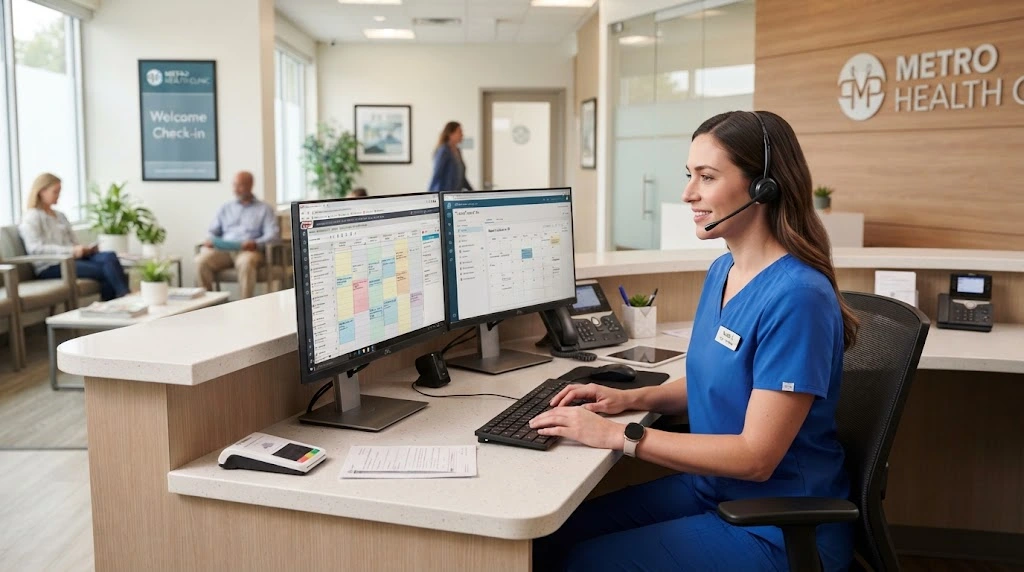
Scheduling is a central part of clinic operations. A reliable system should help staff manage appointments, maintain patient information, coordinate provider availability, and reduce avoidable administrative errors.
Consider whether the platform supports appointment reminders, scheduling adjustments, patient registration, and appropriate access to relevant records. These functions can help administrative teams maintain organized workflows and communicate more effectively with patients.
A Medical Practice Management Solution should also make routine tasks straightforward. If staff must navigate complicated screens or repeatedly enter the same information, the software may create additional work instead of reducing it.
Billing, Claims, and Revenue Cycle Management
Financial administration deserves particular attention because billing inefficiencies can affect cash flow and the clinic’s ability to maintain stable operations.
Look for capabilities that support charge capture, claims submission, payment posting, denial tracking, accounts receivable monitoring, and financial reporting. The system should help staff identify outstanding claims and follow up on unresolved payment issues.
An effective Medical Practice Management Solution can improve visibility across the revenue cycle by organizing important financial information and supporting more consistent workflows.
Nevertheless, software alone cannot guarantee accurate claims or timely reimbursement. Staff training, appropriate coding practices, payer requirements, and regular process reviews remain essential. Clinics should evaluate the platform alongside the quality of their billing procedures.
Reporting and Performance Analytics
Reliable reporting helps clinic leaders understand operational performance. Financial summaries, appointment statistics, billing reports, and productivity indicators can reveal where resources are being used effectively and where improvements may be necessary.
A Medical Practice Management Solution should provide reports that are understandable, relevant, and accessible to authorized personnel.
Before committing to a platform, assess whether its reporting functions can support routine management decisions. Consider how easily staff can retrieve information, compare performance over time, and identify unresolved operational issues.
Clear reporting can strengthen accountability across administrative departments and support more informed planning.
Prioritize Integration and Data Accuracy
Healthcare clinics often rely on multiple digital systems to manage clinical documentation, financial processes, communications, and administrative records. When these systems operate independently, staff may need to enter information repeatedly or reconcile inconsistent records.
Integration should therefore be a major consideration when choosing new software.
Check Compatibility With Existing Systems
A Medical Practice Management Solution should integrate appropriately with the clinic’s existing technology where required. Depending on the organization’s needs, this may include electronic health records, billing platforms, clearinghouses, payment processing tools, and patient communication systems.
Ask prospective vendors which integrations are available, whether additional fees apply, and how information moves between connected platforms. It is also important to understand how integration errors are detected and resolved.
Compatibility should be confirmed before purchasing the system rather than assumed from general marketing statements.
Maintain Consistent and Accurate Information
Accurate information supports effective administration, reliable reporting, and appropriate financial follow-up. Duplicate records, incomplete patient details, and inconsistent billing information can create unnecessary work and increase the likelihood of errors.
A well-selected Medical Practice Management Solution should support appropriate data validation, consistent recordkeeping, and controlled information access.
Clinics should also establish clear procedures for reviewing data quality, correcting inaccuracies, and managing changes to patient or insurance information. Technology works best when supported by dependable administrative practices.
Assess Security, Privacy, and Compliance Requirements
Healthcare organizations handle confidential patient information and sensitive financial records. Protecting this information is a fundamental operational responsibility, not an optional software feature.
Before selecting a vendor, review the platform’s security controls, privacy safeguards, and compliance-related capabilities.
Review Access Controls and Data Protection
Look for role-based access permissions, multifactor authentication, encryption, audit logs, secure backups, and appropriate recovery procedures. These controls help reduce unauthorized access and support the responsible management of sensitive information.
Ask vendors how they manage security incidents, software updates, data retention, and the return or deletion of information when a contract ends.
A Medical Practice Management Solution should also provide clear documentation explaining its security responsibilities and the responsibilities retained by the clinic.
Confirm Applicable Legal Obligations
Compliance requirements depend on the clinic’s location, the information it handles, the services it provides, and its contractual relationships.
For organizations subject to United States healthcare privacy regulations, including HIPAA where applicable, vendors should be evaluated for their ability to support relevant administrative and technical safeguards. Contractual arrangements, including business associate agreements when required, should be reviewed carefully.
Clinics should not assume that purchasing compliant software automatically makes the entire organization compliant. Staff training, internal policies, risk assessments, and appropriate oversight remain necessary.
Consider Ease of Use and Staff Training
Even a technically advanced platform can underperform if employees find it difficult to use. Complicated interfaces, confusing navigation, and inadequate support may slow administrative work and create resistance to change.
Usability should therefore carry significant weight in the selection process.
Request a Practical Software Demonstration
During a vendor demonstration, ask to see the workflows that matter most to your clinic. Assess how easily users can complete routine tasks, locate information, generate reports, and correct administrative errors.
Pay attention to the number of steps required to complete common activities. A streamlined interface can help staff work more consistently, particularly during busy periods.
A Medical Practice Management Solution should make essential tasks easier to manage rather than require employees to adapt to unnecessarily complicated procedures.
Whenever possible, involve representatives from different departments in the evaluation. Their feedback can reveal usability concerns that may not be apparent during a sales presentation.
Evaluate Training and Ongoing Support
Implementation involves more than installing software. Employees need to understand the new workflows, know where to find assistance, and learn how to resolve routine problems.
Ask whether the vendor provides onboarding, training materials, live support, and ongoing technical assistance. Clarify support hours, response expectations, escalation procedures, and any additional charges.
A Medical Practice Management Solution supported by effective training can help clinics establish consistent working practices and reduce avoidable disruptions during the transition.
Compare Pricing and Long-Term Value
Software pricing should be evaluated in relation to the full cost of ownership. The advertised subscription fee may represent only part of the financial commitment.
Clinics should understand the complete pricing structure before making a decision.
Examine the Total Cost of Ownership
Potential costs may include implementation, data migration, training, integrations, additional users, support packages, and future upgrades. Contract terms and renewal conditions also deserve attention.
A Medical Practice Management Solution should fit the clinic’s budget while offering the capabilities necessary to support its operations.
Avoid selecting a platform based exclusively on the lowest initial price. A less expensive system may require additional manual work, while a more comprehensive option may provide better operational value. The appropriate decision depends on the clinic’s requirements and the actual costs associated with each option.
Calculate the Potential Return on Investment
Return on investment should be assessed through measurable operational and financial improvements. Relevant considerations include administrative hours saved, fewer avoidable billing errors, improved claim follow-up, more efficient scheduling, and better visibility into outstanding payments.
Establish a baseline before implementation so that results can be compared against previous performance.
A Medical Practice Management Solution may deliver substantial value when it reduces repetitive work and allows staff to focus on higher-priority responsibilities. However, expected savings should be based on realistic assumptions rather than vendor promises.
Reviewing performance periodically helps clinic leaders determine whether the investment continues to meet organizational needs.
Evaluate Vendor Reliability and Scalability
Choosing software also means establishing a working relationship with the company responsible for maintaining it. Vendor reliability, product development, and customer support can influence the system’s usefulness over several years.
Research the Vendor’s Experience
Assess the vendor’s experience serving healthcare organizations with similar operational requirements. Review available customer feedback, implementation procedures, service commitments, and the quality of technical documentation.
Ask how the company handles product updates, service interruptions, security vulnerabilities, and customer concerns. It is also worth understanding its approach to data ownership and system portability.
A dependable vendor should communicate clearly about capabilities, limitations, support arrangements, and additional costs.
Plan for Future Growth
Your clinic’s requirements may change as patient volume increases, staffing expands, or additional locations are introduced. A platform that meets current needs should not become an unnecessary obstacle to future development.
A scalable Medical Practice Management Solution should accommodate reasonable changes in users, workflows, reporting requirements, and integrations without requiring a complete replacement.
Consider whether the pricing structure remains practical as the organization grows. Understanding these limitations early can prevent avoidable disruption and expensive transitions later.
Plan Implementation Before Making a Commitment
A carefully selected system can still produce disappointing results if implementation is poorly managed. Clinics should establish a realistic transition plan before signing a contract.
Begin by identifying the employees responsible for implementation, the data that must be transferred, the workflows that need adjustment, and the training required before launch.
Data migration deserves particular care. Patient demographics, insurance information, financial records, and other administrative data should be transferred and validated according to applicable legal, contractual, and operational requirements.
Where possible, conduct structured testing before the system becomes central to daily operations. Confirm that users can complete essential tasks, reports produce reliable information, integrations function as expected, and access permissions are appropriate.
A Medical Practice Management Solution should be introduced through a controlled process that minimizes unnecessary disruption. Clear communication helps staff understand what is changing, when changes will occur, and where support is available.
After implementation, monitor performance against the goals established during the initial assessment. Collect staff feedback, review operational indicators, and address recurring problems promptly. This follow-up period is important because some workflow issues become visible only after the system is used under normal operating conditions.
Make a Decision Based on Your Clinic’s Priorities
Choosing the right management platform requires balancing functionality, usability, security, integration, support, and cost. No single product will be the best choice for every healthcare organization.
Start with your operational requirements, compare vendors against consistent criteria, and involve the people who will use the system every day. Review contractual commitments carefully, verify essential capabilities, and avoid making a decision based solely on persuasive demonstrations or extensive feature lists.
For clinics seeking additional operational support, May Medical Solutions offers services designed to help healthcare practices manage administrative and business functions. Its service areas include medical billing, credentialing, staffing, practice management, and revenue cycle management. Evaluating these operational needs together can help practice owners identify where process improvements or external support may be appropriate.
Ultimately, the best Medical Practice Management Solution is one that fits the clinic’s current workflows, protects sensitive information, supports reliable financial administration, and can adapt as requirements evolve. A thoughtful selection process gives healthcare leaders a stronger foundation for improving efficiency while keeping patient care at the center of their operations.
Streamline Your Clinic’s Operations With May Medical Solutions
Managing a healthcare practice requires a coordinated approach to administrative workflows, medical billing, credentialing, staffing, and revenue cycle management. When these responsibilities become difficult to manage, they can consume valuable time, increase operational pressure, and affect financial performance.
May Medical Solutions helps healthcare practices strengthen their operations through medical billing, practice management, provider credentialing, staffing, and revenue cycle management services. With the right operational support, your clinic can improve administrative efficiency, strengthen revenue processes, and dedicate more attention to delivering quality patient care.
Whether you are evaluating a new Medical Practice Management Solution or looking for ways to improve your existing workflows, May Medical Solutions can help you identify opportunities to make your practice more organized and efficient.
Ready to improve your clinic’s operational efficiency? Visit May Medical Solutions to explore our services and discuss how we can support your practice’s administrative and business needs.
Take the next step toward a more efficient, financially organized, and growth-ready healthcare practice.
Frequently Asked Questions
1. What is a Medical Practice Management Solution?
A Medical Practice Management Solution is a software platform or operational system that helps healthcare clinics manage administrative tasks, appointment scheduling, patient registration, billing, insurance claims, and financial reporting. The right solution can improve workflow efficiency and support better practice management.
2. How do I choose the right medical practice management software for my clinic?
Start by identifying your clinic’s operational needs, budget, staffing requirements, and existing technology. Evaluate essential features, integration capabilities, security measures, ease of use, vendor support, and long-term scalability before making a decision.
3. How can a Medical Practice Management Solution improve medical billing?
A suitable solution can help organize claims processing, payment posting, denial tracking, and accounts receivable monitoring. These capabilities can reduce repetitive administrative work, improve billing visibility, and support more consistent revenue cycle management when combined with accurate coding and effective billing procedures.
4. Is a Medical Practice Management Solution suitable for small healthcare practices?
Yes. Small practices can benefit from streamlined scheduling, organized patient information, improved billing workflows, and centralized reporting. Choosing a solution that matches the clinic’s size, budget, and current requirements can help avoid unnecessary costs and complexity.
5. How can May Medical Solutions help improve clinic operations?
May Medical Solutions offers healthcare business support services, including medical billing, provider credentialing, staffing, practice management, and revenue cycle management. These services can help clinics address administrative challenges, improve operational processes, and support sustainable business growth.