
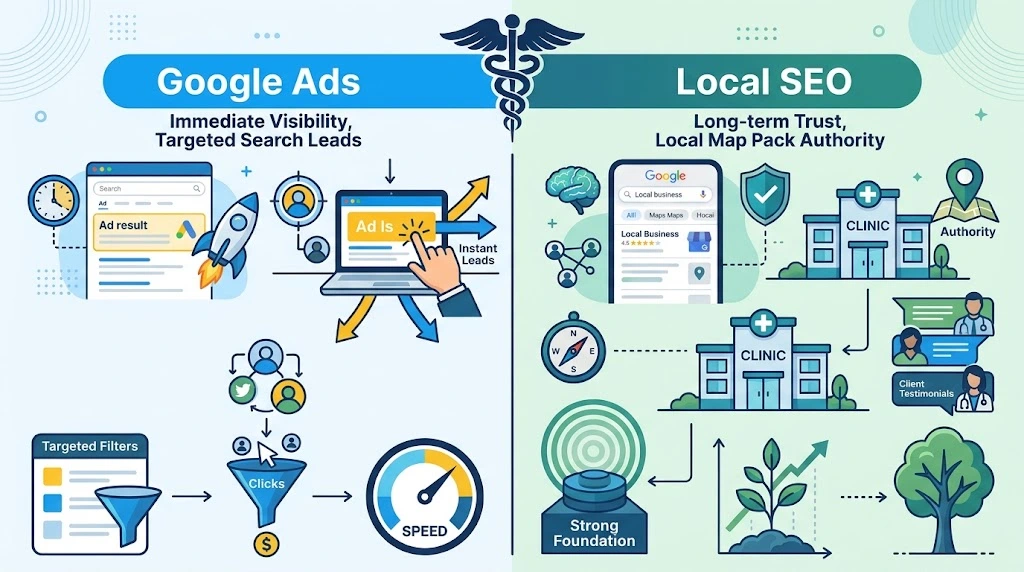
Both approaches can increase visibility, but they operate differently. Google Ads provides paid placement in search results, while local SEO improves a practice’s visibility in unpaid search listings and Google Maps. Each strategy has distinct benefits, costs, and performance considerations that affect how behavioral health organizations allocate their marketing budgets.
Behavioral health practices need a reliable digital marketing strategy to connect with people seeking mental health services. Patients increasingly turn to search engines to find therapists, psychiatrists, counselors, and behavioral health providers. For practice owners, appearing in relevant search results can influence whether potential patients discover their services or choose another provider. Understanding the difference between Google Ads and local SEO is essential for building a sustainable online presence.
The decision is not simply about choosing paid advertising over organic search. Instead, practices should evaluate their growth objectives, available resources, local competition, and ability to convert website visitors into scheduled appointments. A balanced strategy can help providers generate inquiries while strengthening their online presence over time.
Understanding Google Ads and Local SEO
Before investing in digital marketing, behavioral health providers should understand how paid search and local search optimization work. Although both can help practices reach people searching for mental health services, they rely on different mechanisms.
What Is Google Ads?
Google Ads is a paid advertising platform that allows businesses to display advertisements in search results and across Google’s advertising network. Advertisers typically establish campaign budgets, select relevant keywords, create ad copy, and define geographic targeting parameters.
For behavioral health practices, paid search can provide visibility for services that prospective patients are actively researching. Campaigns can be organized around specific treatment areas, provider specialties, service locations, and appointment-related search intent.
One major advantage is control over campaign delivery. Advertisers can adjust budgets, refine targeting, test messaging, and monitor measurable outcomes. However, visibility generally depends on continued advertising expenditure, and campaign performance varies according to competition, relevance, landing-page quality, and bidding strategy.
What Is Local SEO?
Local search engine optimization focuses on improving a practice’s visibility in location-based organic results and Google Maps. It involves optimizing the website, maintaining an accurate Google Business Profile, developing relevant local content, and ensuring consistent business information across trusted online directories.
Local SEO helps search engines understand the services a practice provides, the locations it serves, and its relevance to nearby searchers.
Unlike paid advertising, organic visibility is not purchased through a cost-per-click bidding system. However, it requires ongoing work, including technical maintenance, content development, reputation management, and performance analysis. Results can take time, and rankings are never guaranteed.
Key Differences Between Paid Search and Local SEO
The most effective strategy depends on the practice’s immediate priorities and long-term goals. Understanding the following differences can help decision-makers evaluate both approaches more realistically.
Speed of Visibility
Paid search can generate visibility soon after campaigns are approved and activated. This makes Google Ads useful for practices seeking to increase awareness of available services without waiting for organic rankings to develop.
Local SEO generally requires a longer investment period. Search engines need time to assess a website’s relevance, local signals, content quality, and overall authority. Competition in a particular service area can further influence the timeline.
However, speed alone should not determine a marketing decision. Rapid visibility is valuable only when it reaches the right audience and contributes to meaningful inquiries.
Marketing Costs and Budget Control
Paid advertising usually involves ongoing spending on clicks or other campaign interactions. Costs vary according to competition, targeting, keyword selection, and campaign quality. A high advertising budget does not automatically produce a strong return.
Local SEO involves expenses related to strategy, content, website improvements, technical work, and reputation management. Although it is not free, its benefits can accumulate as a website establishes stronger organic visibility.
When evaluating Google Ads, practices should distinguish between advertising spend and total acquisition costs. Agency fees, landing-page development, call tracking, and conversion measurement may also affect the overall investment.
Local SEO should be assessed using the same discipline. The absence of a direct charge for each organic click does not mean that achieving and maintaining visibility requires no resources.
Long-Term Sustainability
Paid search visibility typically declines when campaigns stop running. A practice may therefore need to maintain advertising expenditure to preserve its existing level of paid exposure.
Organic search performance can be more sustainable when supported by useful content, a technically sound website, and consistent local optimization. Nevertheless, rankings can change as competitors improve their websites, search algorithms evolve, and local market conditions shift.
For this reason, Google Ads and local SEO should be assessed as different marketing assets rather than interchangeable services. One offers controllable paid exposure, while the other aims to develop lasting discoverability.
Why Local SEO Matters for Behavioral Health Practices
Local visibility is particularly important in behavioral healthcare because many patients seek services within a practical geographic area. Even when telehealth is available, patients often want to understand where a provider operates, which states they serve, and whether the services meet their needs.
Optimizing Google Business Profile
A complete and accurate Google Business Profile helps eligible practices communicate essential information to prospective patients. Details such as business hours, contact information, website links, service categories, and location information should remain accurate.
Practices should also review their eligibility and follow Google’s guidelines, particularly when operating from shared offices, private residences, or virtual-only arrangements. A profile should accurately represent a genuine, eligible business location rather than being created solely to target additional cities.
Accurate information reduces uncertainty and makes it easier for prospective patients to determine whether a provider is relevant to their needs.
Creating Helpful, Location-Relevant Website Content
Local landing pages should explain available services, provider qualifications, treatment approaches, appointment arrangements, and geographic coverage. Content must provide genuine value rather than repeating city names or publishing near-identical pages for multiple locations.
Strong local content also supports trust. Mental health decisions are personal, and prospective patients may need clear information before feeling comfortable contacting a practice.
Google Ads can direct searchers to relevant service pages, but the landing page still needs to answer their questions clearly. Similarly, organic visitors are more likely to engage when the information they find is specific, accessible, and accurate.
Building a Trustworthy Online Reputation
Reviews and reputation management can influence how people perceive a behavioral health provider. Practices should follow platform policies, protect patient confidentiality, and avoid incentives or pressure that could compromise the authenticity of reviews.
Healthcare organizations must take particular care when responding publicly to feedback. Confirming that someone is a patient or discussing treatment details can create privacy concerns.
A professional reputation strategy focuses on accurate business information, respectful communication, and consistent service quality rather than attempting to manipulate ratings.
How Paid Search Supports Patient Acquisition
Although local SEO helps build long-term visibility, paid search can complement organic efforts by providing additional exposure for relevant searches.
Reaching High-Intent Searchers
Paid search campaigns can target people actively searching for behavioral health services. Advertisers can organize campaigns by service category, location, and other permitted targeting criteria.
A carefully structured Google Ads campaign should use relevant keywords, appropriate geographic settings, clear messaging, and landing pages that reflect the advertised service. These elements help reduce irrelevant traffic and improve the likelihood that visitors find useful information.
Campaign managers should also review search-term reports, where available, to identify irrelevant queries and refine keyword targeting. Negative keywords can help prevent ads from appearing for unsuitable searches, although they require ongoing maintenance.
Managing Campaign Performance
Paid campaigns offer measurable data, including impressions, clicks, cost, and recorded conversions. These metrics help practices understand whether their advertising is reaching the intended audience.
However, clicks and impressions do not necessarily represent patient acquisition. A campaign may attract considerable traffic without producing qualified inquiries or completed appointments.
To evaluate Google Ads effectively, practices should configure conversion tracking carefully. Tracked actions may include appropriate appointment requests or completed contact forms, provided measurement practices comply with applicable privacy requirements.
Phone calls and appointment bookings should also be evaluated thoughtfully. A single inquiry is not always equivalent to a new patient, and reporting should reflect the difference between initial contact and actual service engagement.
Compliance and Privacy Considerations in Healthcare Marketing
Behavioral health marketing requires greater care than many other forms of digital promotion because campaigns may involve sensitive health-related information.
Protecting Patient Information
Practices should review applicable privacy laws, advertising platform policies, and relevant healthcare regulations before launching campaigns. In the United States, HIPAA obligations may apply depending on the organization’s status and activities.
Advertising pixels, analytics tools, call-tracking services, and third-party integrations should be reviewed for their handling of personal and health-related information. Organizations should not assume that a technology vendor or advertising platform automatically makes a particular tracking arrangement compliant.
Sensitive health information should not be shared with advertising platforms without an appropriate legal basis and compliance review. Campaign audiences should also be designed carefully, avoiding practices that could expose or infer an individual’s mental health condition.
Maintaining Ethical Advertising Practices
Marketing content should accurately describe provider credentials, services, treatment availability, and expected outcomes. Claims about treatment effectiveness must be supportable, and advertising should never promise guaranteed recovery.
Google Ads campaigns must comply with applicable advertising policies, including restrictions that may apply to healthcare services, personalized advertising, and sensitive-interest targeting. Policies can vary by service category and jurisdiction, so campaign requirements should be checked before launch.
Local SEO content also requires ethical oversight. Accurate service descriptions, genuine qualifications, and responsible patient communication help support credibility without exploiting the concerns of vulnerable individuals.
How to Measure Success Across Both Strategies
A meaningful marketing evaluation looks beyond traffic volume. Behavioral health practices should identify which activities produce relevant inquiries, improve visibility, and support sustainable business performance.
Track Relevant Performance Metrics
For paid search, useful metrics include cost per click, conversion rate, cost per qualified inquiry, and the proportion of inquiries that lead to scheduled appointments. Where reliable and privacy-compliant data is available, practices can also assess the cost of acquiring a new patient.
For local SEO, important indicators include organic search impressions, relevant clicks, local search visibility, Google Business Profile interactions, website engagement, and qualified appointment inquiries.
Google Search Console can help evaluate organic search performance, while Google Analytics and suitable appointment or customer relationship management systems may provide additional insights when configured appropriately.
Evaluate Return on Investment
The financial value of a marketing channel depends on more than its immediate cost. Practices should consider the quality of inquiries, appointment attendance, available clinical capacity, and the resources required to maintain marketing activities.
Google Ads may offer a measurable acquisition pathway when campaigns are properly configured, but performance can fluctuate with competition and changing demand. Local SEO may generate continuing organic visits over time, although its contribution can be difficult to isolate precisely.
Attribution also deserves attention. A prospective patient may discover a practice through organic search, return through Google Ads, and contact the office later. Reporting systems should account for these overlapping touchpoints where possible rather than automatically crediting one channel with the entire outcome. By analyzing Google Ads alongside organic search performance, practices can better understand the customer journey and make more informed marketing investment decisions.
Building a Balanced Digital Marketing Strategy
For many behavioral health practices, the strongest approach is not an exclusive commitment to paid advertising or organic search. It is a coordinated strategy that reflects current business priorities and available resources.
Start With Business Objectives
use google ads 1 time in this para
Practices should first identify whether they need immediate visibility, stronger local recognition, improved website performance, or more consistent appointment inquiries. Google Ads can help address immediate visibility needs, while local SEO supports long-term discoverability. The right approach depends on the practice’s goals and available marketing resources.
A practice entering a competitive market may prioritize paid search while building its organic foundation. An established provider with steady demand may place greater emphasis on technical improvements, local content, and reputation management.
These priorities should be reviewed regularly rather than treated as permanent decisions.
Coordinate Paid and Organic Efforts
Keyword research can inform both paid campaigns and website content planning. Search-term insights may reveal the language prospective patients use, while organic search performance can help identify services and topics that deserve additional attention.
A coordinated Google Ads strategy should direct visitors to pages that match their search intent. Local SEO should reinforce the same service information, geographic coverage, and brand messaging without duplicating content unnecessarily.
Practices should also ensure that their websites are mobile-friendly, accessible, secure, and easy to navigate. Clear contact options, transparent service information, and a straightforward appointment process support both paid and organic traffic.
Review Performance and Adjust Investment
Marketing decisions should be based on documented results rather than assumptions about which channel is inherently superior. Regular reviews can identify wasted advertising expenditure, underperforming landing pages, technical SEO problems, and opportunities to improve conversion rates. Google Ads budgets can be adjusted as campaign data develops, allowing practices to refine targeting and improve campaign efficiency. By monitoring Google Ads performance alongside local SEO results, behavioral health practices can make informed decisions about where to invest their marketing resources. Ultimately, Google Ads and local SEO should work together to create a dependable acquisition system that connects relevant searchers with accurate information and appropriate care through ongoing measurement, ethical decision-making, and collaboration between marketing professionals and healthcare leadership.
Frequently Asked Questions
Is Google Ads better than local SEO for behavioral health practices?
Neither approach is universally better. Paid search can provide faster visibility, while local SEO supports organic discoverability and longer-term growth. The right choice depends on the practice’s goals, budget, competition, and existing online presence.
How long does local SEO take to produce results?
Timelines vary according to website quality, competition, location, technical issues, and the consistency of optimization efforts. Some improvements may become visible relatively quickly, while meaningful organic growth can require several months or longer.
Does paid search guarantee new patient appointments?
No. Advertising can increase exposure and generate website visits, but appointments depend on relevance, trust, service availability, website usability, and the effectiveness of the inquiry process.
Can a behavioral health practice use both strategies?
Yes. Practices can combine paid search with local SEO to address immediate visibility needs while building their organic presence. Both strategies should be measured separately and reviewed together.
What should practices consider before launching paid advertising?
Practices should review their marketing objectives, budget, service eligibility, geographic targeting, landing-page quality, conversion tracking, privacy obligations, and applicable advertising policies. Professional oversight can help reduce compliance risks and improve campaign accountability.
Strengthening Behavioral Health Marketing With May Medical Solutions
Effective digital marketing requires more than purchasing advertising or publishing website content. Behavioral health practices need a clear understanding of their audience, a technically sound website, relevant service information, and reliable performance measurement.
May Medical Solutions supports healthcare organizations with digital solutions designed to strengthen their online presence and practice operations. By aligning website development, SEO, and broader marketing priorities, practices can build a more organized approach to digital growth.
The most productive strategy is one that connects visibility with credibility and measurable outcomes. When paid campaigns and local search optimization support the same business objectives, behavioral health providers are better positioned to reach relevant audiences while maintaining responsible, patient-centered communication.